Weather Alerts for Florida
1. Coastal Flood Statement for: Monroe Upper Keys; Monroe Middle Keys
2. Flood Watch for: Inland Volusia; Coastal Volusia; Coastal Indian River; Coastal St. Lucie; Coastal Martin; Inland Northern Brevard; Inland Indian River; Inland St. Lucie; Inland Martin; Mainland Northern Brevard; Northern Brevard Barrier Islands; Inland Southern Brevard; Mainland Southern Brevard; Southern Brevard Barrier Islands
3. Flood Watch for: Metro Palm Beach County; Metro Broward County; Metropolitan Miami Dade; Coastal Palm Beach County; Coastal Broward County; Coastal Miami Dade County
4. High Surf Advisory for: Coastal Nassau; Coastal Duval; Coastal Flagler; Northeast Coastal St. Johns; Southeast Coastal St. Johns; Coastal Glynn; Coastal Camden
5. High Surf Advisory for: Coastal Palm Beach County
6. High Surf Advisory for: Coastal Volusia; Coastal Indian River; Coastal St. Lucie; Coastal Martin; Mainland Northern Brevard; Northern Brevard Barrier Islands; Mainland Southern Brevard; Southern Brevard Barrier Islands
7. Rip Current Statement for: Coastal Broward County; Coastal Miami Dade County
8. Rip Current Statement for: Coastal Franklin
9. Rip Current Statement for: Coastal Nassau; Coastal Duval; Coastal Flagler; Northeast Coastal St. Johns; Southeast Coastal St. Johns; Coastal Glynn; Coastal Camden
10. Rip Current Statement for: Coastal Palm Beach County
11. Rip Current Statement for: Coastal Volusia; Coastal Indian River; Coastal St. Lucie; Coastal Martin; Mainland Northern Brevard; Northern Brevard Barrier Islands; Mainland Southern Brevard; Southern Brevard Barrier Islands
12. Rip Current Statement for: South Walton; Coastal Gulf
13. Wind Advisory for: Coastal Indian River; Coastal St. Lucie; Inland Indian River; Inland St. Lucie
14. Wind Advisory for: Coastal Martin; Inland Martin
15. Wind Advisory for: Inland Flagler; Coastal Nassau; Coastal Duval; Coastal Flagler; Northeast Coastal St. Johns; South Central Duval; Southeast Coastal St. Johns; Northern Inland St. Johns; Southern Inland St. Johns; Western St. Johns
16. Wind Advisory for: Inland Nassau; Eastern Clay; Eastern Putnam; Trout River; Western Duval; Coastal Glynn; Coastal Camden
17. Wind Advisory for: Inland Northern Brevard; Mainland Northern Brevard; Northern Brevard Barrier Islands; Inland Southern Brevard; Mainland Southern Brevard; Southern Brevard Barrier Islands
18. Wind Advisory for: Inland Volusia; Coastal Volusia
19. Wind Advisory for: Northern Lake County; Orange; Seminole; Osceola; Southern Lake County
20. Wind Advisory for: Okeechobee
Want more detail? Get the Complete 7 Day and Night Detailed Forecast!
Current U.S. National Radar--Current
The Current National Weather Radar is shown below with a UTC Time (subtract 5 hours from UTC to get Eastern Time).

National Weather Forecast--Current
The Current National Weather Forecast and National Weather Map are shown below.

National Weather Forecast for Tomorrow
Tomorrow National Weather Forecast and Tomorrow National Weather Map are show below.

North America Water Vapor (Moisture)
This map shows recent moisture content over North America. Bright and colored areas show high moisture (ie, clouds); brown indicates very little moisture present; black indicates no moisture.

Weather Topic: What are Cirrocumulus Clouds?
Home - Education - Cloud Types - Cirrocumulus Clouds
 Next Topic: Cirrostratus Clouds
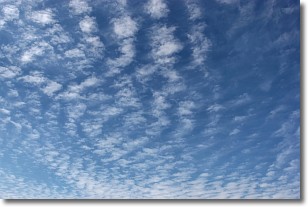
Cirrocumulus clouds form at high altitudes (usually around 5 km)
and have distinguishing characteristics displayed in a fine layer of
small cloud patches. These small cloud patches are sometimes referred to as
"cloudlets" in relation to the whole cloud formation.
Cirrocumulus clouds are formed from ice crystals and water droplets. Often, the
water droplets in the cloud freeze into ice crystals and the cloud becomes a
cirrostratus cloud. Because of this common occurrence, cirrocumulus cloud
formations generally pass rapidly.
Next Topic: Cirrostratus Clouds
Weather Topic: What are Cirrus Clouds?
Home - Education - Cloud Types - Cirrus Clouds
 Next Topic: Condensation
Cirrus clouds are high-level clouds that occur above 20,000 feet
and are composed mainly of ice crystals.
They are thin and wispy in appearance.
What do they indicate?
They are often the first sign of an approaching storm.
Next Topic: Condensation
Current conditions powered by WeatherAPI.com