Weather Alert in Washington
Winter Weather Advisory issued February 16 at 8:50AM PST until February 17 at 12:00PM PST by NWS Seattle WA
AREAS AFFECTED: Willapa and Black Hills; Southern Hood Canal; Lake Crescent Area Including US 101; Foothills of the Western and Southern Olympic Peninsula; Lower Chehalis River Valley
DESCRIPTION: * WHAT...Snow showers expected. Total snow accumulations of 1 to 3 inches. * WHERE...Foothills of the Western and Southern Olympic Peninsula, Lake Crescent Area Including US 101, Lower Chehalis River Valley, Southern Hood Canal, and Willapa and Black Hills. * WHEN...Until noon PST Tuesday. The snow potential will gradually shift southward from the northern Olympic Peninsula today south toward Grays Harbor and the Hood Canal tonight. * IMPACTS...Roads, and especially bridges and overpasses, may become slick and hazardous. Plan on wintry road conditions. The hazardous conditions could impact the Monday evening and Tuesday morning commutes. * ADDITIONAL DETAILS...As of 845 am, snow was being observed along U.S. Highway 101 west of Lake Crescent. Precipitation will come in the form of hit and miss showers while temperatures generally hover in the low to mid 30s. However, quick accumulations will be possible in heavy showers creating rapidly deteriorating road conditions.
INSTRUCTION: Slow down and use caution while traveling. Prepare for possible power outages. Be prepared for wintry road conditions. Slow down and use caution while driving. If you are going outside, watch your first few steps taken on stairs, sidewalks, and driveways. These surfaces could be icy and slippery, increasing your risk of a fall and injury.
Want more detail? Get the Complete 7 Day and Night Detailed Forecast!
Current U.S. National Radar--Current
The Current National Weather Radar is shown below with a UTC Time (subtract 5 hours from UTC to get Eastern Time).

National Weather Forecast--Current
The Current National Weather Forecast and National Weather Map are shown below.

National Weather Forecast for Tomorrow
Tomorrow National Weather Forecast and Tomorrow National Weather Map are show below.

North America Water Vapor (Moisture)
This map shows recent moisture content over North America. Bright and colored areas show high moisture (ie, clouds); brown indicates very little moisture present; black indicates no moisture.

Weather Topic: What are Mammatus Clouds?
Home - Education - Cloud Types - Mammatus Clouds
 Next Topic: Nimbostratus Clouds
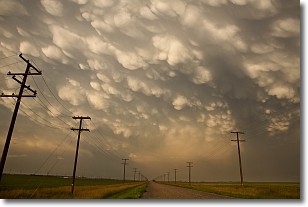
A mammatus cloud is a cloud with a unique feature which resembles
a web of pouches hanging along the base of the cloud.
In the United States, mammatus clouds tend to form in the warmer months, commonly
in the Midwest and eastern regions.
While they usually form at the bottom of a cumulonimbis cloud, they can also form
under altostratus, altocumulus, stratocumulus, and cirrus clouds. Mammatus clouds
warn that severe weather is close.
Next Topic: Nimbostratus Clouds
Weather Topic: What is Precipitation?
Home - Education - Precipitation - Precipitation
 Next Topic: Rain
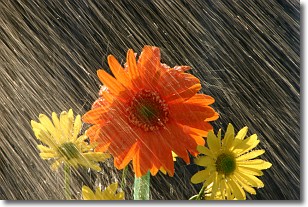
Precipitation can refer to many different forms of water that
may fall from clouds. Precipitation occurs after a cloud has become saturated to
the point where its water particles are more dense than the air below the cloud.
In most cases, precipitation will reach the ground, but it is not uncommon for
precipitation to evaporate before it reaches the earth's surface.
When precipitation evaporates before it contacts the ground it is called Virga.
Graupel, hail, sleet, rain, drizzle, and snow are forms of precipitation, but fog
and mist are not considered precipitation because the water vapor which
constitutes them isn't dense enough to fall to the ground.
Next Topic: Rain
Current conditions powered by WeatherAPI.com