Weather Alert in Alaska
Extreme Cold Watch issued February 7 at 1:27PM AKST until February 11 at 6:00PM AKST by NWS Fairbanks AK
AREAS AFFECTED: Western Arctic Coast; Northwest Arctic Coast; Northern Arctic Coast; Central Beaufort Sea Coast; Eastern Beaufort Sea Coast; Western Arctic Plains; Howard Pass and the Delong Mountains; Central Arctic Plains; Central Brooks Range; Romanzof Mountains
DESCRIPTION: * WHAT...Dangerously cold wind chills as low as 75 below possible. * WHERE...Arctic Coast, Arctic Plains, and Brooks Range Passes. * WHEN...From Sunday evening through Wednesday afternoon. * IMPACTS...The dangerously cold wind chills as low as 75 below zero could cause frostbite on exposed skin in as little as 5 minutes. * ADDITIONAL DETAILS...Moderate winds between 5 to 10 mph are expected to start as early as Sunday night, with increasing winds around 15 to 20 mph expected to peak Tuesday into Wednesday along the Eastern Arctic Coast. Winds gusts may be as high as 60 mph along the Chukchi Sea Coast, while winds in Atigun Pass will remain gusty. This coupled with ambient air temperatures as low as 50 below Monday night into Tuesday, will allow for dangerously cold wind chills to impact much of the Arctic Coast through midweek.
INSTRUCTION: Dress in layers including a hat, face mask, and gloves if you must go outside.
Want more detail? Get the Complete 7 Day and Night Detailed Forecast!
Current U.S. National Radar--Current
The Current National Weather Radar is shown below with a UTC Time (subtract 5 hours from UTC to get Eastern Time).

National Weather Forecast--Current
The Current National Weather Forecast and National Weather Map are shown below.

National Weather Forecast for Tomorrow
Tomorrow National Weather Forecast and Tomorrow National Weather Map are show below.

North America Water Vapor (Moisture)
This map shows recent moisture content over North America. Bright and colored areas show high moisture (ie, clouds); brown indicates very little moisture present; black indicates no moisture.

Weather Topic: What are Cirrocumulus Clouds?
Home - Education - Cloud Types - Cirrocumulus Clouds
 Next Topic: Cirrostratus Clouds
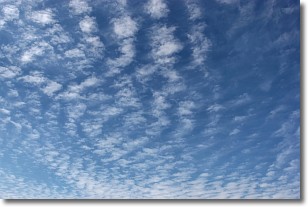
Cirrocumulus clouds form at high altitudes (usually around 5 km)
and have distinguishing characteristics displayed in a fine layer of
small cloud patches. These small cloud patches are sometimes referred to as
"cloudlets" in relation to the whole cloud formation.
Cirrocumulus clouds are formed from ice crystals and water droplets. Often, the
water droplets in the cloud freeze into ice crystals and the cloud becomes a
cirrostratus cloud. Because of this common occurrence, cirrocumulus cloud
formations generally pass rapidly.
Next Topic: Cirrostratus Clouds
Weather Topic: What are Cirrus Clouds?
Home - Education - Cloud Types - Cirrus Clouds
 Next Topic: Condensation
Cirrus clouds are high-level clouds that occur above 20,000 feet
and are composed mainly of ice crystals.
They are thin and wispy in appearance.
What do they indicate?
They are often the first sign of an approaching storm.
Next Topic: Condensation
Current conditions powered by WeatherAPI.com