Weather Alert in Alaska
Special Weather Statement issued March 19 at 2:09PM AKDT by NWS Juneau AK
AREAS AFFECTED: City and Borough of Sitka; Petersburg Borough; Western Kupreanof and Kuiu Island; Prince of Wales Island; City and Borough of Wrangell; Ketchikan Gateway Borough; Annette Island
DESCRIPTION: Snow showers will continue to impact the region through the end of the week, with snow accumulations being limited during the daytime hours. Confidence is increasing on seeing a more significant round of snow this weekend, as cold temperatures aloft remain in place and we see more moisture move in. There remains a lot of uncertainty for snow accumulations at the surface as we are starting to see warmer day time temperatures into the mid to high 30s to around 40 due to increasing daylight and sun angle. Temperatures aloft are still more favorable for accumulating snow amounts. If the precipitation rates are significant enough to overcome the warmer surface temperatures, snow accumulations will be greater. But if the temperatures are able to overcome the precipitation rates, snowfall will be limited as it melts by the time it reaches the surface. This will need to be monitored for any changes in potential snow accumulation. The orientation of the low and where the showers move into the panhandle will also impact the snow amounts, with how northward and inland the heavier moisture will push and how organized the band of showers is expected to be when moving through this weekend. Stay tuned for the latest forecast updates at weather.gov/juneau.
INSTRUCTION: N/A
Want more detail? Get the Complete 7 Day and Night Detailed Forecast!
Current U.S. National Radar--Current
The Current National Weather Radar is shown below with a UTC Time (subtract 5 hours from UTC to get Eastern Time).

National Weather Forecast--Current
The Current National Weather Forecast and National Weather Map are shown below.

National Weather Forecast for Tomorrow
Tomorrow National Weather Forecast and Tomorrow National Weather Map are show below.

North America Water Vapor (Moisture)
This map shows recent moisture content over North America. Bright and colored areas show high moisture (ie, clouds); brown indicates very little moisture present; black indicates no moisture.

Weather Topic: What is Sleet?
Home - Education - Precipitation - Sleet
 Next Topic: Snow
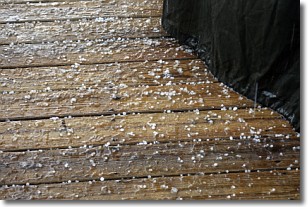
Sleet is a form of precipitation in which small ice pellets are the primary
components. These ice pellets are smaller and more translucent than hailstones,
and harder than graupel. Sleet is caused by specific atmospheric conditions and
therefore typically doesn't last for extended periods of time.
The condition which leads to sleet formation requires a warmer body of air to be
wedged in between two sub-freezing bodies of air. When snow falls through a warmer
layer of air it melts, and as it falls through the next sub-freezing body of air
it freezes again, forming ice pellets known as sleet. In some cases, water
droplets don't have time to freeze before reaching the surface and the result is
freezing rain.
Next Topic: Snow
Weather Topic: What are Stratocumulus Clouds?
Home - Education - Cloud Types - Stratocumulus Clouds
 Next Topic: Stratus Clouds
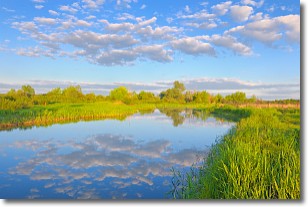
Stratocumulus clouds are similar to altocumulus clouds in their
fluffy appearance, but have a slightly darker shade due to their additional mass.
A good way to distinguish the two cloud types is to hold your hand out and measure
the size of an individual cloud; if it is the size of your thumb it is generally
an altocumulus cloud, if it is the size of your hand it is generally a
stratocumulus cloud.
It is uncommon for stratocumulus clouds to produce precipitation, but if they do
it is usually a light rain or snow.
Next Topic: Stratus Clouds
Current conditions powered by WeatherAPI.com