Weather Alert in Montana
Winter Storm Warning issued March 11 at 9:21AM MDT until March 14 at 12:00PM MDT by NWS Missoula MT
AREAS AFFECTED: Butte/Blackfoot Region
DESCRIPTION: * WHAT...Heavy snow and blowing snow expected. There is a likelihood of major winter weather impacts to isolated extreme winter storm impacts. Total snow accumulations of 10 to 20 inches for Highway 12 over MacDonald Pass and Georgetown Lake and the higher terrain. Total snow accumulations of 1 to 6 inches at lower elevations. Winds gusts between 40 to 60 mph, with gusts of 60 to 80 mph at higher elevations. * WHERE...Butte, Highway 12 Garrison to Elliston, Georgetown Lake, MacDonald Pass, and Homestake Pass. * WHEN...From midnight tonight to noon MDT Saturday. * IMPACTS...Visibilities may drop below 1/4 mile due to falling and blowing snow. The strong winds and weight of snow on tree limbs may down power lines and could cause sporadic power outages. For MAJOR winter weather impacts, expect considerable disruptions to normal activities. Dangerous or impossible traveling conditions. Avoid travel in the impacted areas if possible. Widespread closures and disruptions to infrastructure may occur. For EXTREME winter storm impacts, expect substantial disruptions to normal activities. Extremely dangerous or impossible traveling conditions. Travel in the impacted areas is not advised. Extensive and widespread closures and disruptions to infrastructure may occur. Life saving actions may be needed. The hazardous conditions could impact the Thursday morning and evening commutes, especially over higher passes. Very strong winds could cause extensive tree damage. * ADDITIONAL DETAILS...The greatest concern for strong and damaging winds across lower elevations is focused along the Interstate 90 corridor between Garrison Junction and Anaconda. Periods of blizzard conditions will impact MacDonald Pass, the Georgetown Lake area, and the higher elevations Thursday morning.
INSTRUCTION: Persons should delay all travel if possible. If travel is absolutely necessary, drive with extreme caution and be prepared for sudden changes in visibility. Leave plenty of room between you and the motorist ahead of you, and allow extra time to reach your destination. Avoid sudden braking or acceleration, and be especially cautious on hills or when making turns. Make sure your car is winterized and in good working order. Do not touch downed lines and report any power outages to your electric company. Travel is highly discouraged due to slick roadways and the possibility of downed trees and power lines.
Want more detail? Get the Complete 7 Day and Night Detailed Forecast!
Current U.S. National Radar--Current
The Current National Weather Radar is shown below with a UTC Time (subtract 5 hours from UTC to get Eastern Time).

National Weather Forecast--Current
The Current National Weather Forecast and National Weather Map are shown below.

National Weather Forecast for Tomorrow
Tomorrow National Weather Forecast and Tomorrow National Weather Map are show below.

North America Water Vapor (Moisture)
This map shows recent moisture content over North America. Bright and colored areas show high moisture (ie, clouds); brown indicates very little moisture present; black indicates no moisture.

Weather Topic: What are Cirrocumulus Clouds?
Home - Education - Cloud Types - Cirrocumulus Clouds
 Next Topic: Cirrostratus Clouds
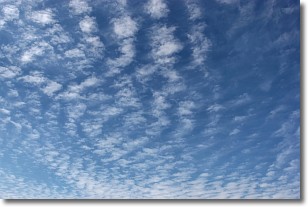
Cirrocumulus clouds form at high altitudes (usually around 5 km)
and have distinguishing characteristics displayed in a fine layer of
small cloud patches. These small cloud patches are sometimes referred to as
"cloudlets" in relation to the whole cloud formation.
Cirrocumulus clouds are formed from ice crystals and water droplets. Often, the
water droplets in the cloud freeze into ice crystals and the cloud becomes a
cirrostratus cloud. Because of this common occurrence, cirrocumulus cloud
formations generally pass rapidly.
Next Topic: Cirrostratus Clouds
Weather Topic: What are Cirrus Clouds?
Home - Education - Cloud Types - Cirrus Clouds
 Next Topic: Condensation
Cirrus clouds are high-level clouds that occur above 20,000 feet
and are composed mainly of ice crystals.
They are thin and wispy in appearance.
What do they indicate?
They are often the first sign of an approaching storm.
Next Topic: Condensation
Current conditions powered by WeatherAPI.com